
(Part 2)”Data Can Move Itself” — Cold and Hot Migration with Adaptive Thresholds: How to Maximize Long-Term Experience


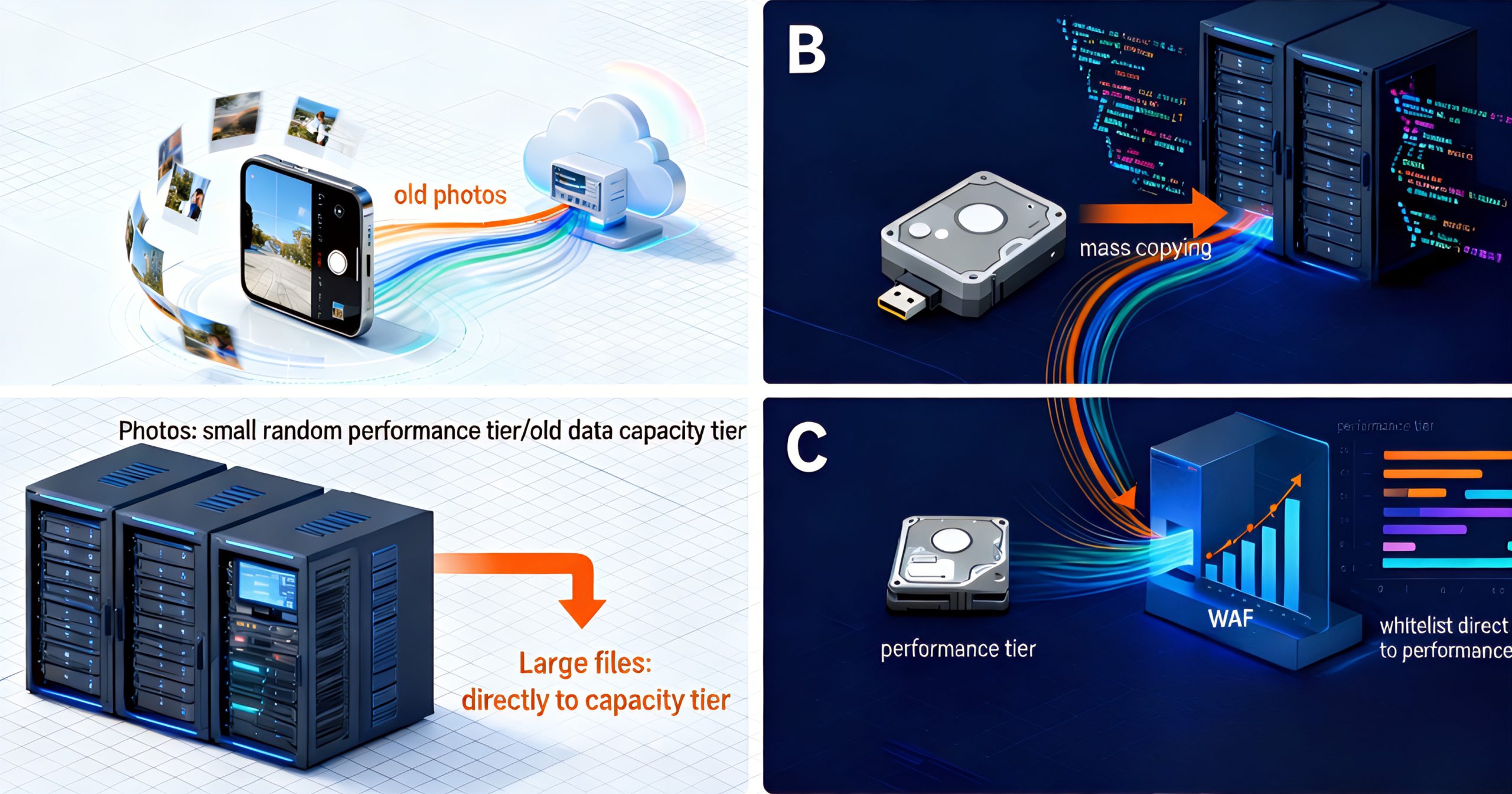
Scenario A: Photo Burst + Cloud Backup in Background
Scenario B: One-Time Massive Copy (e.g., 4K Video or CAD Project)
Scenario C: System Log Surge (e.g., Debugging or Telemetry Spikes)
In short: migration prepares the ground for GC/WL/Trim to operate more efficiently—synergy, not redundancy.
|
Stakeholder |
Value Delivered |
|---|---|
|
End Users |
Not “slower over time”—but smarter over time. Photos, app updates, and large copies no longer interfere with each other. |
|
Creators & Power Users |
Smooth concurrent workflows: edit a 10GB project while exporting 4K renders—no speed surprises over weeks or months. |
|
Enterprises & Developers |
Clear observability (tier hit ratio, WAF, p99 latency); policy is host-transparent; zero application modifications required to benefit. |
|
Myth |
Reality |
|---|---|
|
“Background migration is just wasted movement.” |
Migration is budgeted, hysteresis-gated, and whitelist/blacklist-protected. Its value shows in three dimensions: improved steady-state latency, reduced WAF, and extended device lifespan. |
|
“Frequent threshold tuning causes instability.” |
Tuning targets trends, not transient noise. With built-in hysteresis bands and signal filtering, adjustments are gradual—“slow optimization,” not “erratic flipping.” |
|
“Just add more cache!” |
Cache is a resource, not a strategy. Without intelligent placement, cold data still hoards hot space. Policy beats capacity—smart allocation outperforms brute-force scaling. |
Q: Will background migration impact my current task? A: No. It runs at low priority with strict resource quotas and yields instantly under foreground pressure.
Q: What if workload suddenly shifts (e.g., from light editing to bulk export)? A: Threshold adaptation monitors occupancy and latency trends in real time. Within a few control windows (~seconds to minutes), the system converges to a new steady state—automatically rebalancing tiers.
Q: Could sensitive data (e.g., logs or metadata) be accidentally demoted? A: Extremely unlikely. Critical regions are explicitly whitelisted for performance-tier residency only, and demotion requires both low heat score and sustained inactivity (hysteresis). Safety first.
Hot/cold migration puts data in the right place. Adaptive thresholds keep the system in the right state. Foreground agility + background diligence + closed-loop tuning—together, they deliver simultaneous excellence in speed, stability, and endurance.
No trade-offs. Just smarter storage. :)